

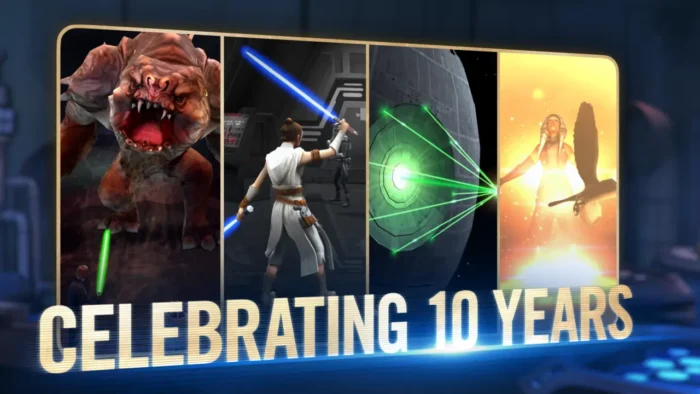
Star Wars: Galaxy of Heroes is celebrating its 10-year anniversary is style, releasing its biggest update ever: a full structural reboot of how SWGOH works, with new modes, new progression rules, new economy, new seasonal format, and the first meaningful shake-up to endgame power since Relics dropped.
Today, I am here to tell you everything about SWGOH’s Era of Anniversary, now that some time has passed since it was announced and we know EVERYTHING about it.
Eras: the New “Seasons” of the Game
This is the backbone of the entire patch, with everything changed to fit the new Era system. These are basically seasons, but with the following composition:
- 3 Episodes
- 6 Marquee characters
- 1 Journey Guide unit
- Weekly Episode Quests
- Era Challenges
- Unique Era-only materials and progression
A standard Era lasts long enough to give players time to build, upgrade, and use the season’s roster, but non-standard Eras (shorter ones, one-Episode Eras, Eras without a Journey unit) may happen occasionally.
An important change is that engaging with Episode content now has a MUCH lower entry point. Before, you needed to be level 85 to engage with Episode content. Now, starting with Level 10, you can already access Episode Quests, Episode Track, and Episode Pass. Character Quests now unlock at Level 20.
While this won’t affect veterans at all, it gives new players more rewards sooner, hopefully turning them into players who will keep returning to the game.
New Unit Categories
This 10th Anniversary Patch brings the biggest structural changes in Star Wars: Galaxy of Heroes. All units are now categorized as either:
- Era Units (Only usable in Era content. Only upgradeable using Era materials.)
- Legacy Units (Every unit from previous Eras + every old unit in the game.)
Era Unigts can’t enter Legacy modes and Legacy Units can’t enter Era modes.
This solves the long-standing balance nightmare where new players and day-one veterans exist in the same meta but at wildly different power ceilings.
It also lets the devs design seasonal content where every player starts with:
- identical base-level units,
- identical upgrade paths,
- and identical access to the marquee lineup.
No more “this new character is useless unless you have 12 other relics at R7+.” No more “new players can’t touch new events.” Now everyone plays the new season together.
Era Journey Guide: How It Works Now
Journey Units inside an Era function differently than the old, permanent Journey events:
- Unlock starts at Week 9 of an Era (aligned with the 5th marquee).
- You get the Journey Unit at 4 stars if you meet the requirements.
- Requirements scale with marquee star levels:
- Tier I – 5 marquees at 4 stars
- 5-star upgrade: 5 marquees at 5 stars
- 6 stars / 7 stars: requires all 6 marquees at 6 and 7 stars
- Long after an Era ends, the Journey becomes a Legacy event with different requirements.
Era Levels
Another important change, the new progression system replaces Gear/Relics for Seasonal Play. Era Levels:
- Upgrade stats and abilities linearly.
- Require Era Materials (unique seasonal resources).
- Are gated by star level:
- 4-star: required for Era Level 66+
- 5-star: required for 76+
- 6-star: required for 86+
- 7-star: required for 91+
When the Era ends, your Era Level converts into traditional SWGOH power (below are some examples provided by CG):
- Era Level 65 – Level 85 / Gear 12 (base) / Ability 7
(This is the expected F2P landing point.) - Era Level 80 – Level 85 / Relic 2 / Ability 7
- Era Level 95 (Max) – Level 85 / Relic 6 / Ability 8 (Zeta)
This is the mechanism that makes seasonal progression feed directly into your permanent roster.
The Coliseum Game Mode
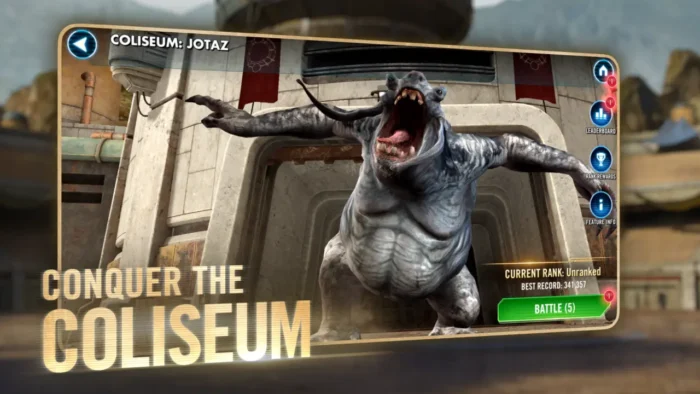
This is the new seasonal flagship mode, and honestly, it’s the most “video game” SWGOH has felt in years. I am sure everybody is having fun with it right now, but here’s what you should know about it:
- The Coliseum unlocks at Player Level 10
- It features daily-rotating bosses
- You push for high scores, not wins/losses
- Rewards both:
- one-time milestone rewards (reset each Era)
- daily leaderboard rewards
- It’s a source of Relic 10 materials
Coliseum shards are completely separate from Squad/Fleet Arena shards and are reshuffled each Era. Bosses include:
- Dryax
- Jotaz
- Pirate AT-ST
- Zeffo Tomb Guardians
I also wrote an in-depth SWGOH Coliseum guide here – make sure to read it for even more details.
Era Challenges Replace Galactic Challenges
Galactic Challenges are gone. Era Challenges replace them now and they:
- Run weekly (in the downtime between marquees)
- Are tuned for Era Units ONLY
- Have tiered difficulty tied to Era Level benchmarks
CG claims this will reduce daily playtime, but we’ll see how Coliseum + Challenges actually feel once the live grind begins – and early on it might take us a bit longer to play them, as we get used to the new system.
And this still doesn’t change the core mechanics, just the way we play some challenges (so these still stand: Best SWGOH Characters for DoT, Best First Order Squads, Best Tank Characters in SWGOH, or the Best Characters for Evading Attacks).
Cantina Overhaul (First Phase)
The old Light Side and Dark Side tables are merged into one unified campaigns table. This is an early move toward a much bigger Cantina rework planned for next year, aiming for better navigation, more seasonal ties and a more modernized home screen.
Right now, the Best SWGOH Early Game Cantina Farms are still valid, and I would focus on them if needed since things might change in the near future.
Loaned Units & Era PvP
These are planned mechanics for the future, as we need some time adjusting to all the major changes brought to the game by this latest patch.
Still, we know that the upcoming Loaned Units will be designed to round-out squads with no investments required. These are temporary, Era-only versions of existing characters and they will be removed at the end of the Era.
Era PvP is also coming later and will not use traditional mods, but a new stat-differentiation system. It requires Loaned Units to maintain seasonal parity and is basically how the developers plan to avoid the broken chaos that would happen if R9+ Legacy monsters fought baby Era Units.
Legacy Mode + Cadence Adjustments
Even though the game is moving to the new Era content, Legacy content isn’t dead. CG is still supporting raids, territory battles, long-term farms and new units outside of Eras.
But there will be some marquee cadence changes, listed below:
- All 6 Era marquees are granted to players at the start of an Era (locked until their event goes live).
- Farming rules updated:
- Shipments – 2 weeks after Era ends
- Hard nodes – ~13 weeks after Marquee
- Accelerated – around 1 year after the Era begins
- Lightspeed Token eligible at the same “1 year after Era start” mark.
Relics, Gear, and the New Power Ceiling
If Eras are the “what” of the 10-year update, the Relic changes are the “how much pain does this actually remove?” For once, the answer is: quite a bit.
Capital Games is trying to make Relics 1–9 significantly easier to reach, while introducing Relic 10 as a new prestige tier for high-end PvP players and top guilds.
Less Gear Choke, More Efficient Relics
One of the quiet but important side effects of the Era system is that it reduces how much traditional gear you need for new units.
Because Era Levels convert into Legacy levels, gear, Relics and abilities at the end of each season, you are no longer forced to pour gear into fresh characters just to get them functional.
Instead, you can push Era Levels during the season and then send your leftover gear to the Scavenger for Relic materials.
Era rewards also flow back into older “Journey Guide” style grinds. Lightspeed Tokens earned during Eras can be used to fast-track classic squads instead of farming every single piece by hand.
On top of that, the Relic 9 recipe is being simplified: Fragmented Signal Data, Chromium Transistors and Aurodium Heatsinks are being removed from the R9 requirements.
That means fewer bottlenecks and a smoother ramp if you’re trying to push several squads up the ladder at once.
More Relic Materials From Regular Play
Relic materials themselves are getting a buff through the Episode Track. The free track will now hand out materials for Relics 1–5 and Tier 1–3 Signal Data instead of the old Galactic Challenge salvage boxes.
If you actually engage with Eras on a daily basis, you’ll now see that reflected in your permanent roster, not just in seasonal toys.
Episode Shipments are also being upgraded. They’ll start selling Signal Data such as Fragmented and Incomplete variants, letting you dump your Episode currency directly into Relic progress rather than leaving it stranded behind low-impact items.
The underlying idea is simple: play the seasonal content, and your Legacy roster gets stronger in a visible, mechanical way.
Scavenger and Raid Token Changes
The Scavenger is being reworked to give better access to high-end Relic components like Aeromagnifiers and Droid Brains.
New recipes allow you to break down items such as Mk 12 ArmaTek Tactical Data Prototypes, Kyrotech Shock Prod Prototypes and Kyrotech Battle Computer Prototypes (and their salvage) into points that can be spent on these top-tier materials.
These pieces are now craftable through more flexible combinations of existing gear.
Signal Data also gets a direct crafting route. A new Corrupted Signal Data recipe lets you combine lower tiers – Fragmented, Incomplete and Flawed Signal Data – into the higher-level resource at defined point values.
Again, it’s about turning old clutter and mixed stockpiles into something you can actually use.
Raid Shipments are being made cheaper and friendlier to lower-tier token owners. Electrium Conductors and Zinbiddle Cards are moving from Mk III to Mk II Raid Tokens, while core Relic components such as Carbonite Circuit Boards, Bronzium Wiring, Chromium Transistors and Aurodium Heatsinks are dropping from Mk II to Mk I tokens with lowered individual costs.
All of this is aimed squarely at the same target: making the climb from Relic 0 upward less miserable.
Looser Star Requirements for Relics
The star gates on Relic levels are also being relaxed:
- Relic 4 now only requires a five-star character instead of six.
- Relic 5 now needs six stars instead of seven.
- Relic 6 becomes the first Relic tier that actually demands a seven-star unit.
For roster builders, that means you can push more characters higher, earlier, without needing to commit to a full seven-star investment right away.
Relic 10: A New Ceiling for Competitive Play
While Relic 9 becomes more accessible, Capital Games is adding Relic 10 as the new top-end target.
Relic 10 materials will come from Era Shipments and are clearly aimed at the sharp end of the player base: competitive Grand Arena Championship players and top Territory War guilds.
Relic Delta
Relic Delta is the system that scales outgoing damage based on the Relic difference between attacker and defender.
After playtesting and feedback, the studio has locked in a final curve: if both sides have the same Relic level (a Delta of zero), there is no damage change.
As the difference grows, the damage modifiers run from heavy penalties at negative deltas to large bonuses at positive ones, roughly spanning from about –60% to +150% across the range from –5 to +5 Relic levels.
The bigger the gap, the more the higher-Relic squad hits like a truck. Capital Games says it has reduced the impact at small differences and toned down the extremes at the top end compared to early tests, but this is still a meaningful shift: Relic advantage will matter more than ever when squads clash.
Relic Delta will not be active in Conquest during the Stranger arc. It is slated to kick in for the Conquest arc that follows, after some quality-of-life changes meant to soften pain points and keep the system’s impact net positive.
Episode Track, Daily Quests and the Death of Galactic Challenges
Because Galactic Challenges are being retired and reborn as Era Challenges, their Episode Points had to be relocated. Capital Games is shifting that value into Episode Quests instead.
Free Episode Quests will now award 5,000 Episode Points, up from 2,000. Quests tied to the paid Episode Pass jump from 4,000 to 7,000 points. Chapter Headline Quests go from 8,000 to 11,000 points. On top of that, a brand-new Daily Quest for playing Coliseum is being added.
Daily rewards are being slightly reshuffled: each individual Daily Quest pays out 300 Episode Points instead of 350, but completing all Daily Quests now yields 1,600 points instead of 1,500.
In total, that works out to a small net gain – roughly 4,000 Episode Points per Episode from dailies instead of 3,950, or around 1,400 extra points per Episode for players who actually clear their checklist.
To make it easier for you, I have a guide on all SWGOH characters that inflict vulnerable.
Lightspeed Tokens 2.0
Lightspeed Tokens, which instantly boost characters to fixed power levels, are being updated to match the current state of the game. Existing tokens will stay as they are, but new Tokens will follow a five-tier structure.
Carbonite-tier Tokens will take a character to level 85, three stars, Gear XII and modest ability levels. Bronzium moves that up to four stars and Relic 1.
Chromium bumps the unit to five stars and Relic 3. Aurodium raises them to six stars and Relic 5. At the top, Kyber Tokens will deliver a level 85, seven-star character at Relic 6 with high-end ability upgrades.
Other benefits for each tier remain as before. The main change is that when you spend one of these new Lightspeed Tokens, the character lands much closer to “plug into a real team now” instead of sitting at an awkward halfway point.
10th Anniversary Era: Familiar Faces, Modern Kits
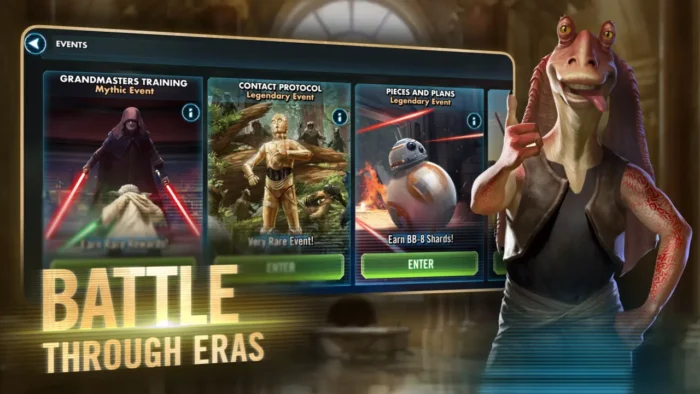
For the 10th Anniversary Era, Capital Games is going back to launch-era characters and giving them modern, meta-relevant versions designed either to revive old squads or to finally anchor “homeless” characters.
Stormtrooper Luke is a direct upgrade over Farmboy Luke and is designed to pull Stormtrooper Han and Princess Leia into a proper Rebel squad alongside R2-D2 and Old Ben. It’s a pre-Leia-Organa Rebel team for players who haven’t reached Galactic Legends yet.
IG-90 continues the IG-86/IG-88 lineage and finally gives Doctor Aphra’s squad a dedicated tank, something that line-up badly needed. Yoda & Chewie is a mash-up unit that pairs Clone Wars Chewbacca with Jedi Master Yoda and slots into Tarrful’s Wookiee squad as a serious power piece.
Asajj Ventress (Dark Disciple) appears in her bounty hunter phase and is meant to join Scion’s squad, giving that group extra punch and narrative flavor.
Inquisitor Barriss shows Barriss Offee in her fallen phase, strengthening Inquisitorius squads in 3v3 and also acting as a potential Unaligned Force User target for Cere Junda. Finally, Darth Vader (Duel’s End) is an Elite Marquee that joins the Stranger and the Emperor’s Hand as the backbone of a fresh Empire squad.
Maul (Hate-Fueled): The Anniversary Journey Unit
The Era Journey Guide unit for this anniversary season is Maul (Hate-Fueled). In this version, Maul has rebuilt his body from scrap and pure rage and now serves the Stranger, leading a new composition in Era content.
The Journey event begins when the fifth marquee of the Era goes live. At that point, players can unlock Maul at four stars and earn enough shards to push him to five stars.
Once the sixth and final marquee releases, the last tiers of the event open up, allowing players to take Maul to six and seven stars before the Era ends. As with all Era units, he uses Era Levels during the season and then converts into a fully integrated Legacy character afterward.
Anniversary Quest Celebration: Lightspeed Farms for a Year
Alongside the Title Update, Capital Games is launching a long-running Anniversary Quest Celebration: six months of quest chains that will remain available until November 17, 2026. These quests appear in Journey Quest logs for anyone at player level 10 or above.
Most of the Lightspeed Tokens from these chains will take characters directly to seven stars, Gear XIII (Relic 0) and fully upgraded abilities, including Zetas but not Omicrons. A few special characters do not receive star upgrades but still get the same boost to level, gear and abilities once unlocked.
Across six waves of quest chains, players will be able to supercharge a wide range of squads: Phoenix (Hera, Sabine, Ezra, Chopper, Captain Rex), key Rebels and Empire staples such as Emperor Palpatine and R2-D2, Jedi anchors like Ahsoka, Anakin, Mace, Shaak Ti, Kelleran Beq and Grand Master Yoda, the Inquisitorius roster, the classic Rebel core around Leia, Farmboy Luke, Old Ben, Stormtrooper Han, Ackbar and Commander Luke, bounty hunters including Boba, Bossk, IG-88, Dengar, Fennec and Chewbacca, and finally the Mandalorian group with Mando, Cara Dune, IG-11, Kuiil, Greef Karga and Beskar Mando.
For brand-new and returning players, this is effectively a fast pass through multiple cornerstone farms that would previously have taken months or years to complete.
What It All Means for SWGOH Players
For active players, this update marks a clear shift. You will be living inside Eras from now on, and your time spent in seasonal content will directly translate into a stronger Legacy roster.
The Relic floor is rising for most of the player base, while Relic 10 becomes the new trophy tier for competitive PvP.
New and returning players get massive on-ramps through Anniversary quests and tuned-up Lightspeed Tokens. Long-time veterans get new Empire, Wookiee, Rebel, Scion, Aphra and Inquisitor squads, a fresh Maul, and a real reason to log in daily for Coliseum runs and Era progression.
It is not a perfect system, and it will almost certainly need tuning. But in terms of scale, this is the biggest structural change Star Wars: Galaxy of Heroes has ever seen.
With this 10th Anniversary update, Capital Games is declaring that SWGOH is now a seasonal live-service RPG, not just a rotating carousel of events, and the next few Eras will determine whether it pays off or just adds another spreadsheet on top of everything we already manage.